Patient and Carer Tool FAQ
Updated 25.06.26
This is a working document developed to support organisations and stakeholders ahead of the release of NACEL data into the public domain in August 2026. The FAQ has been created to provide guidance and answer common questions relating to the data release and associated Patient and Carer Tool. Content will be reviewed and updated regularly as further information becomes available.
If you have any questions about the tool or require additional support, please contact the NACEL Support Team nhsbn.nacelsupport@nhs.net
1) What is the Patient and Carer Tool?
The NACEL Patient and Carer Tool was published in 2025 to make the audit’s findings accessible to patients, carers and anyone interested in end-of-life care in hospitals at a regional or national level, this was Phase 1. This tool is now in development to allow the public view data for individual hospitals; this is Phase 2.
Data for England, Wales and Jersey is included within the Patient and Carer Tool, supporting transparency and quality improvement across nations. You can find out more about the Phase 2 development of the NACEL Patient and Carer Tool here.
The 5 metrics included in the tool are:
Key Indicator
1. Proportion of patient clinical notes with documented evidence that the patient participated in personalised care and support planning conversations
2. Proportion of patient clinical notes with documented evidence of an assessment of the spiritual/religious/cultural needs of those important to the patient (or where not possible, a reason was recorded)
3. Proportion of bereaved people that report the dying person was given enough pain relief
4. Proportion of bereaved people that rated the overall care and support given to themselves and others by the hospital as excellent or good
5. Proportion of hospital/sites with face-to-face specialist palliative care service (doctor and/or nurse) available 8 hours a day, 7 days a week
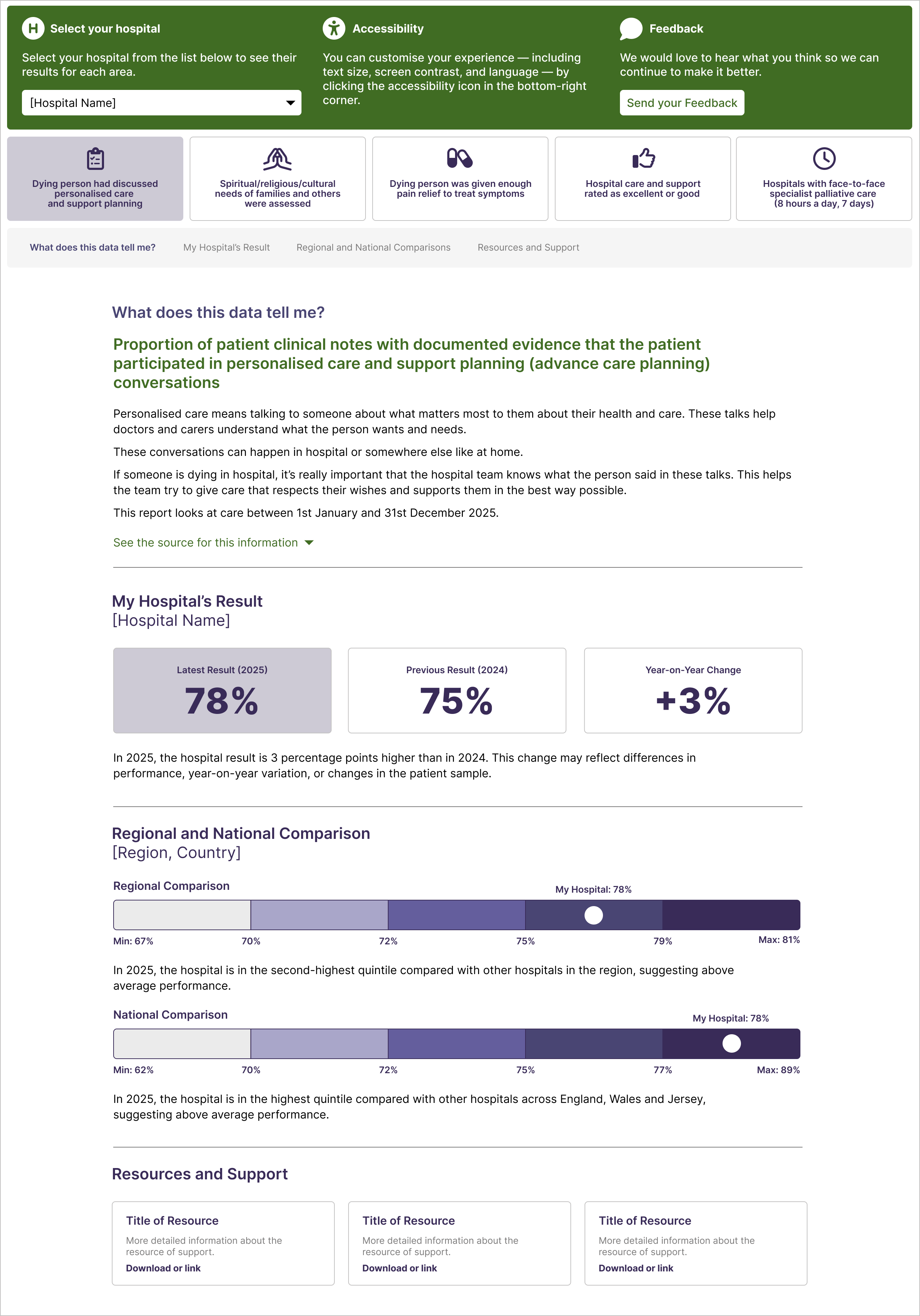
An example view of the upcoming Patient and Carer Tool can be found here.
2) How do I see my hospitals data prior to the launch?
Prior to the data being public in August 2026, you can view your hospital's data via the Data and Improvement Tool. If you do not have an account, you will need to register, and the site Administrator (Project Lead) will have the capability to accept/deny your request. Patient and Carer Tool data is found on the NACEL Dashboard tab under the January 2025 – December 2025 sub-tab and January 2024 – December 2024 sub-tab. Data from both years will be visible on the Patient and Carer Tool in August 2026. You may wish to think about how you make the data accessible and visible within your organisation ahead of time.
For example:
Option 1
You can share a screen shot of the data table, or
Option 2
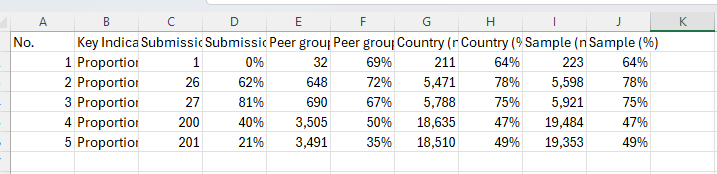
Copy and paste the data in the same format as the table into an Excel sheet
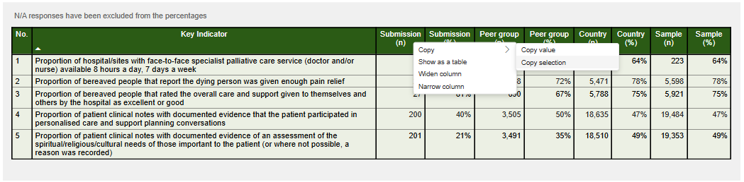
Step 1: Right click on the ‘Submission (n)’ column, hover cursor over ‘Copy’, and then select ‘Copy selection’
Step 2: Open Excel and paste into any cell. You may now create a table and format it how you wish.
3) What should I do in preparation of publication in August?
To prepare for publication in August:
Ensure your hospital board, communications team and patient/carer experience teams are aware of the date for release of your hospital level data.
Ensure you are familiar with your Organisational data or organisation's findings in the Data and Improvement Tool.
The January-December 2025 dashboard has a ‘Patient and Carer Tool’ tab which displays hospitals’ results for the 5 metrics at a regional level. The same is done for 2024.
Share your local NACEL data with governance structures /Board
Discuss the Patient and Carer Tool with the board and executives responsible for PEOLC in the hospital as well as at meetings you feel relevant e.g. ICB or Health Boards and Trusts (Wales) level meetings, End of Life Care groups.
Think about how you might want to share information with frontline staff who may encounter questions about the information in the tool (see section 5).
Think about your local strategy/plan about sharing information publicly such as whether you want to do this proactively or reactively.
Share your quality improvement plans relating to end of life care with your ICB/Health Board and Trusts as per NACEL 2024 National Recommendation 1.
For support with QI – The NACEL QI webpages can be found here.
Register to attend the next QI webinar on improving patient and carer experience on 18th June and upcoming NACEL drop-in sessions on the 2nd June and 21st July 2026 which will focus on the Patient and Carer Tool. Register here.
4) What should I do about my data?
Now that you have access to your data and have reviewed it:
Work with your organisation
Share your local NACEL data with governance structures /Board
Discuss the Patient and Carer Tool with the board and executives responsible for PEOLC in the hospital as well as at meetings you feel relevant e.g. ICB or Health Boards and Trusts (Wales) level meetings, End of Life Care groups.
Share your quality improvement plans relating to end of life care with your ICB/Health Board and Trusts as per NACEL 2024 National Recommendation 1.
For support with QI – The NACEL QI webpages can be found here.
Accessing resources and support from the NACEL Team
Register to attend the next QI webinar on improving patient and carer experience on 18th June and upcoming NACEL drop-in sessions on the 2nd June and 21st July 2026 which will focus on the Patient and Carer Tool. Register here.
To access QI resources and templates, please find the documents on the NACEL portal.
To view examples of innovation and improvement shared by hospitals through NACEL, please check out case studies in the Good Practice Compendium.
An email template to send to staff with resources for responding to questions about the Patient and Carer Tool is available here.
5) How should I communicate with staff about the patient and carer tool?
It is helpful to decide whether you wish to email staff ahead of the launch or when the tool launches, or both. Consider preparing a local document with your results and relevant resources. An email template that can be used as a template to send to your staff is available here.
An example support sheet for healthcare professionals to help patients, carers and bereaved people understand nationally available data on the quality of care at the end of life is available here. Please edit as you wish.
6) How should I manage patient and carer feedback?
An example support sheet for healthcare professionals to help patients, carers and bereaved people understand nationally available data on the quality of care at the end of life is available here.
To view information and resources to provide support alongside the tool, you may find this document here.
7) What should I do if my data looks bad?
Organisations whose data may be seen negatively should prepare for publication in August:
Ensure your hospital board, communications team and patient/carer experience teams are aware of the date for release of your hospital level data.
Ensure you are familiar with your Organisational data or organisation's findings in the Data and Improvement Tool.
The January-December 2025 dashboard has a ‘Patient and Carer Tool’ tab which displays hospitals’ results for the 5 metrics at a regional level. The same is true of 2024.
Share your local NACEL data with governance structures / Board as soon as it is published.
Discuss the Patient and Carer Tool with the board and executives responsible for PEOLC in the hospital as well as at meetings you feel relevant e.g. ICB or Health Boards and Trusts (Wales) level meetings, End of Life Care groups.
Share your quality improvement plans relating to end of life care with your ICB/Health Board and Trusts as per NACEL 2024 National Recommendation 1.
For support with QI – The NACEL QI webpages can be found here.
Register to attend the next QI webinar on improving patient and carer experience on 18th June and upcoming NACEL drop-in sessions on the 2nd June and 21st July 2026 which will focus on the Patient and Carer Tool. Register here.
8) What should I do if my data looks good?
Organisations should still consider that experiences from patients and families may not align with the data, so you should still prepare for publication:
Ensure your hospital board, communications team and patient/carer experience teams are aware of the date for release of your hospital level data.
Ensure you are familiar with your Organisational data or organisation's findings in the Data and Improvement Tool.
The January-December 2025 dashboard has a ‘Patient and Carer Tool’ tab which displays hospitals’ results for the 5 metrics at a regional level.
Share your local NACEL data with governance structures / Board as soon as it is published.
Discuss the Patient and Carer Tool with the board and executives responsible for PEOLC in the hospital as well as at meetings you feel relevant e.g. ICB or Health Boards and Trusts (Wales) level meetings, End of Life Care groups.
Share your quality improvement plans relating to end of life care with your ICB/Health Board and Trusts as per NACEL 2024 National Recommendation 1.
For support with QI – The NACEL QI webpages can be found here.
Register to attend the next QI webinar on improving patient and carer experience on 18th June and upcoming NACEL drop-in sessions on the 2nd June and 21st July 2026 which will focus on the Patient and Carer Tool. Register here.
9) How should I share the data with patients and carers?
The data will be available publicly and updated annually in August. This will happen automatically following submission of your NACEL data for the previous year.
Patient and carer involvement is essential to improve care. Think about whether you want to proactively share the information on the tool or only respond if questions are asked.
For consideration:
Do you have resources that you can share with patients and carers if they are worried about an issue highlighted on the tool?
Ensure that any patient experience team or similar is aware of the tool, and check whether they can offer any help.
10) How does the tool report my hospital results if my hospital has a low number of deaths? Do I need to do any preparation?
If your hospital has less than 20 responses for any metrics then data will be suppressed, this is known as small number suppression. This is for data protection reasons to prevent identification where the sample size is small, and further reduces the results being (fully) misrepresented.
The metric will appear blank and an explanation will be visible to explain why no data is available to be shared.
Small number suppression is applied to public reports. The team responsible for the national audit of care at the end of life will be able to see all feedback to the Trust. We are grateful for each response submitted for the Trust as it supports learning and improvement.
We recommend that you communicate with staff explaining what the tool is, why limited data will be shown for your hospital and signposting to any resources to answer questions. You may want to also take the opportunity to remind staff what quality improvement work is being done or has been done in end of life care.
11) How representative is the NACEL data of patients and bereaved persons’ experiences of care at the end of life in hospital settings?
Nationally, the NACEL Case Note Review data represents approximately 8% of all hospital deaths in England and Wales, based on Office for National Statistics (ONS)figures. The team approximate that the Bereavement Survey data is available for 2% of all hospital deaths. However, participation varies between hospitals/trusts, so representation is not uniform across all sites. A summary of the sampling approach and variation in data submissions during the NACEL 2025 cycle is available here.