
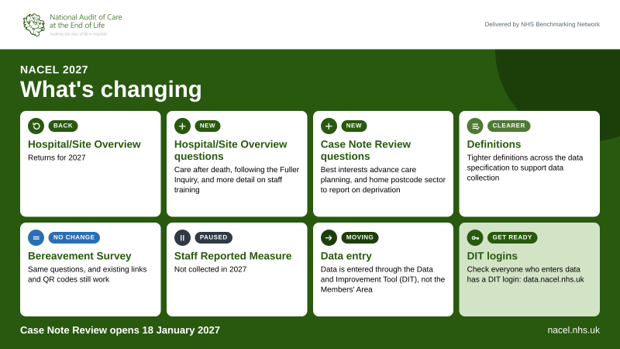
The National Audit of Care at the End of Life (NACEL) 2027 starts collecting data in January. This year's audit is shorter where it can be, asks new questions where gaps existed, and looks for the first time at how hospitals care for people after death.
Every year, NACEL looks at the care people receive in hospital in the last days of their life, and the support given to those important to them. Hospitals in England, Wales and Jersey use the results to see where care is working well and where it needs to improve.
Before each new round, we review every question with the NACEL Steering Group, our clinical team and the people who collect the data. For 2027 we asked a simple question of each one: does this help hospitals improve care? Here is what changed as a result.
Care after death is now part of the audit
The 2025 independent inquiry into the dignity and security of people after death, known as the Fuller Inquiry, made recommendations for NHS organisations.
The Hospital/Site Overview, an organisation-level questionnaire last collected in 2025, returns in 2027 with a new section on this. Hospitals will be asked whether their Board has reviewed progress against the inquiry's recommendations, whether their Chief Nurse holds executive responsibility for safeguarding people after death, whether safeguarding training and policy cover care after death, and whether they report incidents where the transfer of a person after death was not respectful, dignified and discreet.
A clearer picture of staff training
The returning Hospital/Site Overview also asks more detail about end of life care training: which staff groups it reaches, from doctors and nurses to porters and administrative staff, how often refresher training happens, and which topics it covers, such as recognising when someone is dying and spiritual, religious and cultural care.
Fewer questions where the answer was already clear
The Case Note Review, where hospital staff review the records of people who died, has been reduced from 40 to 36 questions.
When staff assessed a patient's agitation or breathlessness, an action to address it was recorded around 98% of the time. Asking about the action told us little, so the audit now concentrates on whether the assessment happens at all.
Questions on learning disability, autism and severe mental illness diagnoses have also been removed. The numbers in each hospital were too small to support local improvement. Two years of this data remain available.
New questions where there were gaps
Not everyone is able to take part in planning their own future care. Until now, the audit only recorded planning conversations with the patient themselves. A new question asks whether planning took place in the person's best interests, with family, friends or the healthcare team.
The audit will also record the first part of the person's home postcode. This will allow NACEL to report on whether care differs between more and less deprived areas, alongside existing reporting by ethnicity.
Hearing from bereaved families
The NACEL Bereavement Survey stays the same in 2027, so results can be compared over time. Our focus this year is on helping hospitals reach more bereaved people, including groups who are currently under-represented, so that the survey reflects a wider range of experiences.
The Staff Reported Measure will not run in 2027.
What happens next
Case Note Review data collection begins on 18th January 2027. Results are fed back to hospitals through the NACEL Data and Improvement Tool from April 2027, and selected results are published for the public through the Patient and Carer Tool.
This year, hospitals will enter their data through the NACEL Data and Improvement Tool (DIT) rather than the NHSBN Members' Area. We advise all organisations to check that everyone who enters data has a DIT login before the Case Note Review opens. Staff without a login can register at https://data.nacel.nhs.uk/register/, and their organisation's Project Lead approves access. Registration for the audit itself will move to the DIT once it is ready; until then, organisations should continue to use the NHSBN Members' Area. More guidance on using the DIT to enter data will follow shortly.
Hospital teams can find the NACEL 2027 guidance and data specifications on the NACEL Portal and can contact the NACEL Support Team at nhsbn.nacelsupport@nhs.net or 0161 521 0866.